Article A49 · Book 1 · Loose insert
Come now, ladies, don't we serve God by being gainfully employed as well as by prayers?
I'VE received in the mail this week a postcard from a friend in France with the news that some 30,000 churches are up for sale.
It is not that the France of today is any less religious than the France of yesterday — though this may be anxiously debated. But the movement towards the cities has killed many villages, each with its own little church.
This is not a recent phenomenon either: about five years ago, in fact, the French government decided to spend several million francs to maintain some of these churches, each an architectural wonder, as tourist attractions.
The question is, does this make the French people less godly? Is the government, by turning the churches into practical use, guilty of a [hei]nous crime?
Who knows? The fact is, the churches have ceased to be churches since there are no more faithful in the villages. So why not sell them?
I know, however, that in the West Indies we can easily believe that even to conceive such an idea can be considered a capital offence. Earlier this year, for instance, when Archbishop Pantin asked a few people whether he should give up Archbishop's House, Catholics were scandalised.
And years ago, when the Roman Catholic church at La Veronica, Caura, had to be demolished to give way to the Caura Dam, the parish priest could not resist the temptation to curse the project and to prophesy that the worst would happen — which apparently did.
We have, in fact, in the West Indies a fierce belief that churches are holy places in which a child may not even smile and that they must not be put to any use except prayers.
This has led some priests to say, cruelly perhaps, that West Indians worship churches, not God.
I remember, indeed, the controversy which arose two years ago when Fr. Michael Pascall allowed Cedrosians to use the church at Bonasse Village for their Carnival Queen show. People everywhere said he was desecrating the church.
It was the same kind of injured response we got from most Catholics when the black power demonstrators "invaded" the Cathedral in February 1970. (Ten of them were later arrested and charged, in fact, with disorderly behaviour in a place of worship — though the charges were later abandoned.)
But just as Father Pascall refused to see any sin in his parishioners using the church for a Carnival show, so too the Archbishop courageously maintained that the Cathedral had not been desecrated because people who believed that they were violently oppressed had entered its doors, not to pray but to protest.
I admit: I was as confused as anybody else that day. All my training, all that I had been taught made me reject their right to carry their protest into the church.
The fact is, we seldom get beyond our first catechetical instruction.
And yet, on the other side of the coin, my instincts told me that the church belonged to the people, to everybody, not to just an elite group who worship one day a week. And why shouldn't God, if he existed in churches only, be made aware of their plight?
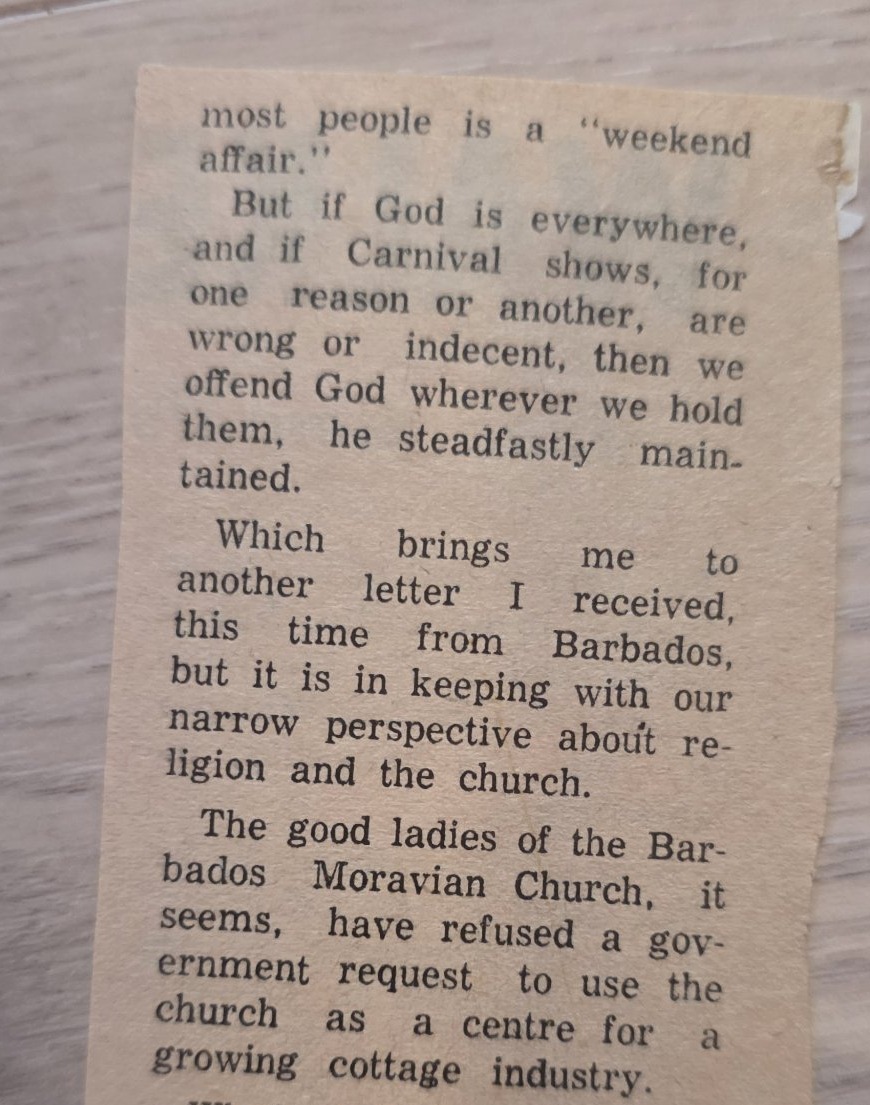
This is the crux of the matter: we act as though God really does exist in churches only. This is why Father Pascall could say later on that religion for most people is a "weekend affair."
But if God is everywhere, and if Carnival shows, for one reason or another, are wrong or indecent, then we offend God wherever we hold them, he steadfastly maintained.
Which brings me to another letter I received, this time from Barbados, but it is in keeping with our narrow perspective about religion and the church.
The good ladies of the Barbados Moravian Church, it seems, have refused a government request to use the church as a centre for a growing cottage industry.
Why? Don't we serve God by our hands as well as by our lips?