Article A48 · Book 1 · Loose insert
Bridging the gap between the priest and the people
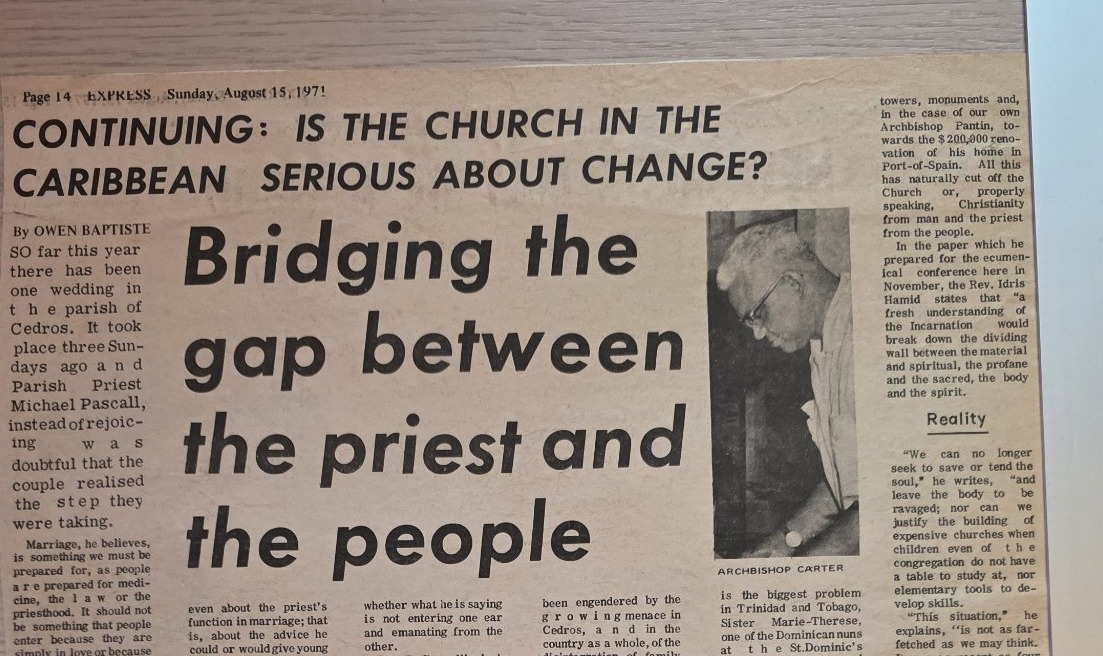
CONTINUING: IS THE CHURCH IN THE CARIBBEAN SERIOUS ABOUT CHANGE?
By OWEN BAPTISTE
SO far this year there has been one wedding in the parish of Cedros. It took place three Sundays ago and Parish Priest Michael Pascall, instead of rejoicing, was doubtful that the couple realised the step they were taking.
Marriage, he believes, is something we must be prepared for, as people are prepared for medicine, the law or the priesthood. It should not be something that people enter because they are simply in love or because their parents insist that that is the only way they will be allowed to remain in the house.
Fr. Pascall is doubtful even about the priest's function in marriage; that is, about the advice he could or would give young people bent on marriage two or three weeks before the event. Even as he officiates at the ceremony, he wonders whether what he is saying is not entering one ear and emanating from the other.
But Fr. Pascall's lack of faith is not based on any cynicism for the institution of marriage; on the contrary, it has been engendered by the growing menace in Cedros, and in the country as a whole, of the disintegration of family life.
His fears are not imaginary. Family life or the lack of family life is the biggest problem in Trinidad and Tobago. Sister Marie-Therese, one of the Dominican nuns at the St. Dominic's Home, said recently, and the after-care officers attached to the Home agreed, with accounts of parents neglecting or totalling disowning [as printed] their children.
And last week, when flood waters made living in the Lady Hochoy's Home for Retarded Children uncomfortable, only six parents of 180 children in the Home responded to the nuns' appeal in the first two days to collect their children, exposed to the damp and, possibly, illness.
This is the anxiety which lawyers have also expressed in their criticisms of the proposed Status of Children Act, which they claim will further undermine family life and inevitably destroy marriage as an institution because of the posthumous right of any woman to claim inheritance (for her children) from any man.
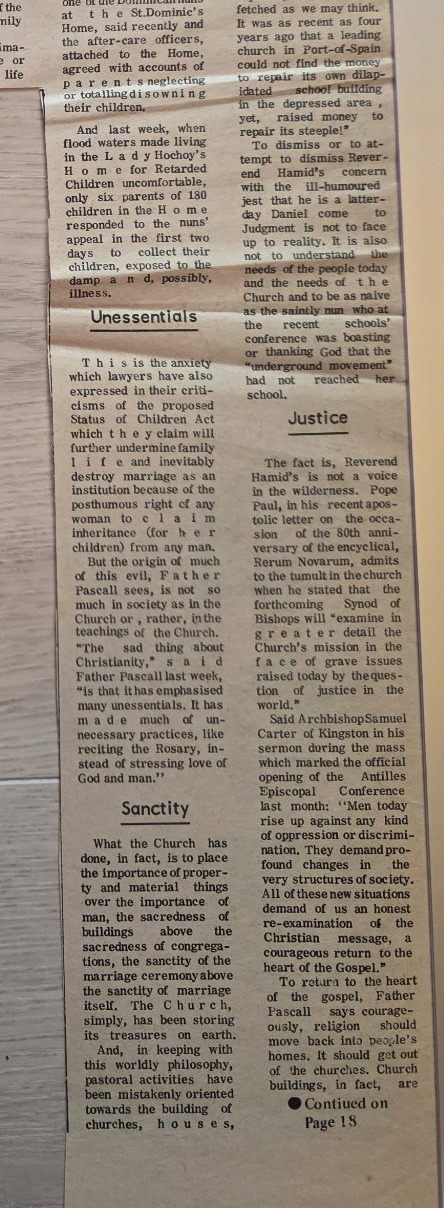
But the origin of much of this evil, Father Pascall sees, is not so much in society as in the Church or, rather, in the teachings of the Church. "The sad thing about Christianity," said Father Pascall last week, "is that it has emphasised many unessentials. It has made much of unnecessary practices, like reciting the Rosary, instead of stressing love of God and man."
What the Church has done, in fact, is to place the importance of property and material things over the importance of man, the sacredness of buildings above the sacredness of congregations, the sanctity of the marriage ceremony above the sanctity of marriage itself. The Church, simply, has been storing its treasures on earth. And, in keeping with this worldly philosophy, pastoral activities have been mistakenly oriented towards the building of churches, houses, towers, monuments and, in the case of our own Archbishop Pantin, towards the $200,000 renovation of his home in Port-of-Spain. All this has naturally cut off the Church or, properly speaking, Christianity from man and the priest from the people.
In the paper which he prepared for the ecumenical conference here in November, the Rev. Idris Hamid states that "a fresh understanding of the Incarnation would break down the dividing wall between the material and spiritual, the profane and the sacred, the body and the spirit."
"We can no longer seek to save or tend the soul," he writes, "and leave the body to be ravaged; nor can we justify the building of expensive churches when children even of the congregation do not have a table to study at, nor elementary tools to develop skills.
"This situation," he explains, "is not as far-fetched as we may think. It was as recent as four years ago that a leading church in Port-of-Spain could not find the money to repair its own dilapidated school building in the depressed area, yet, raised money to repair its steeple!"
To dismiss or to attempt to dismiss Reverend Hamid's concern with the ill-humoured jest that he is a latter-day Daniel come to Judgment is not to face up to reality. It is also not to understand the needs of the people today and the needs of the Church, and to be as naive as the saintly nun who at the recent schools' conference was boasting or thanking God that the "underground movement" had not reached her school.
The fact is, Reverend Hamid's is not a voice in the wilderness. Pope Paul, in his recent apostolic letter on the occasion of the 80th anniversary of the encyclical, Rerum Novarum, admits to the tumult in the church when he stated that the forthcoming Synod of Bishops will "examine in greater detail the Church's mission in the face of grave issues raised today by the question of justice in the world."
Said Archbishop Samuel Carter of Kingston in his sermon during the mass which marked the official opening of the Antilles Episcopal Conference last month: "Men today rise up against any kind of oppression or discrimination. They demand profound changes in the very structures of society. All of these new situations demand of us an honest re-examination of the Christian message, a courageous return to the heart of the Gospel."
To return to the heart of the gospel, Father Pascall says courageously, religion should move back into people's homes. It should get out of the churches. Church buildings, in fact, are
becoming the greatest stumbling blocks to Christianity, he says.
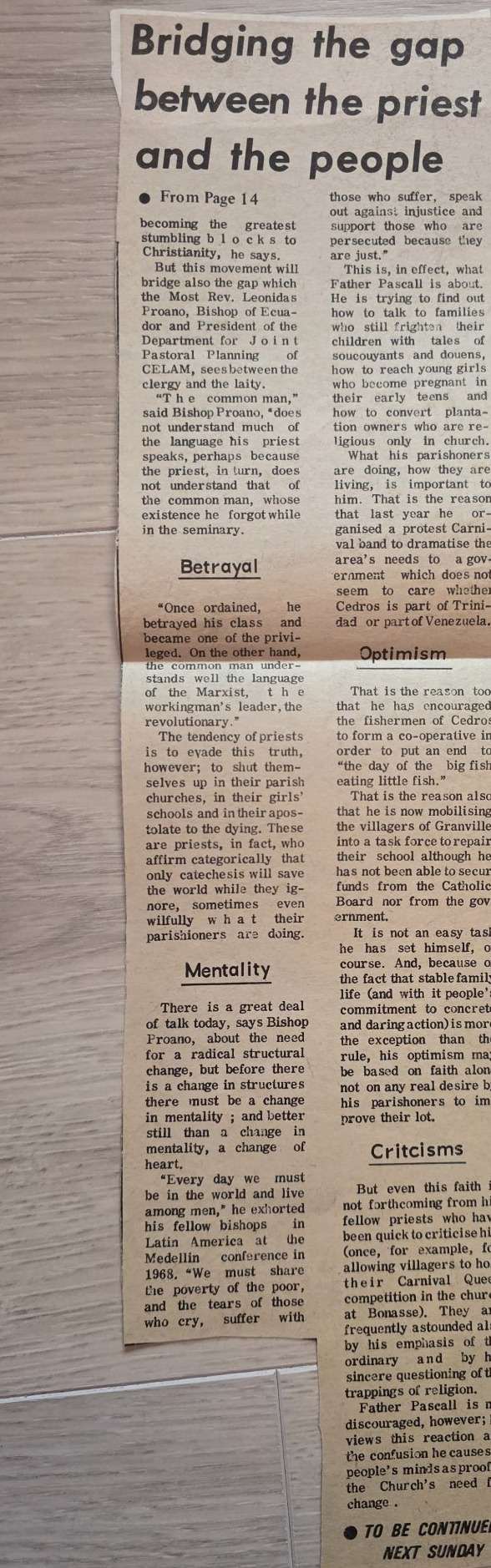
But this movement will bridge also the gap which the Most Rev. Leonidas Proano, Bishop of Ecuador and President of the Department for Joint Pastoral Planning of CELAM, sees between the clergy and the laity.
"The common man," said Bishop Proano, "does not understand much of the language his priest speaks, perhaps because the priest, in turn, does not understand that of the common man, whose existence he forgot while in the seminary.
"Once ordained, he betrayed his class and became one of the privileged. On the other hand, the common man understands well the language of the Marxist, the workingman's leader, the revolutionary."
The tendency of priests is to evade this truth, however; to shut themselves up in their parish churches, in their girls' schools and in their apostolate to the dying. These are priests, in fact, who affirm categorically that only catechesis will save the world while they ignore, sometimes even wilfully, what their parishioners are doing.
There is a great deal of talk today, says Bishop Proano, about the need for a radical structural change, but before there is a change in structures there must be a change in mentality; and better still than a change in mentality, a change of heart.
"Every day we must be in the world and live among men," he exhorted his fellow bishops in Latin America at the Medellin conference in 1968. "We must share the poverty of the poor, and the tears of those who cry, suffer with those who suffer, speak out against injustice and support those who are persecuted because they are just."
This is, in effect, what Father Pascall is about. He is trying to find out how to talk to families who still frighten their children with tales of soucouyants and douens, how to reach young girls who become pregnant in their early teens and how to convert plantation owners who are religious only in church.
What his parishioners are doing, how they are living, is important to him. That is the reason that last year he organised a protest Carnival band to dramatise the area's needs to a government which does not seem to care whether Cedros is part of Trinidad or part of Venezuela.
That is the reason too that he has encouraged the fishermen of Cedros to form a co-operative in order to put an end to "the day of the big fish eating little fish."
That is the reason also that he is now mobilising the villagers of Granville into a task force to repair their school although he has not been able to secure funds from the Catholic Board nor from the government.
It is not an easy task he has set himself, of course. And, because of the fact that stable family life (and with it people's commitment to concrete and daring action) is more the exception than the rule, his optimism may be based on faith alone not on any real desire by his parishioners to improve their lot.
But even this faith is not forthcoming from his fellow priests who have been quick to criticise him (once, for example, for allowing villagers to hold their Carnival Queen competition in the church at Bonasse). They are frequently astounded also by his emphasis of the ordinary and by his sincere questioning of the trappings of religion.
Father Pascall is not discouraged, however; he views this reaction and the confusion he causes in people's minds as proof of the Church's need for change.
● TO BE CONTINUED NEXT SUNDAY
[Photograph in the page-14 clipping: Archbishop Carter.]