Article A46 · Book 1 · Scrapbook page pp.35–39 (p.35 = Spear contents page, magazine p.3)
Father Pascal — The people's priest
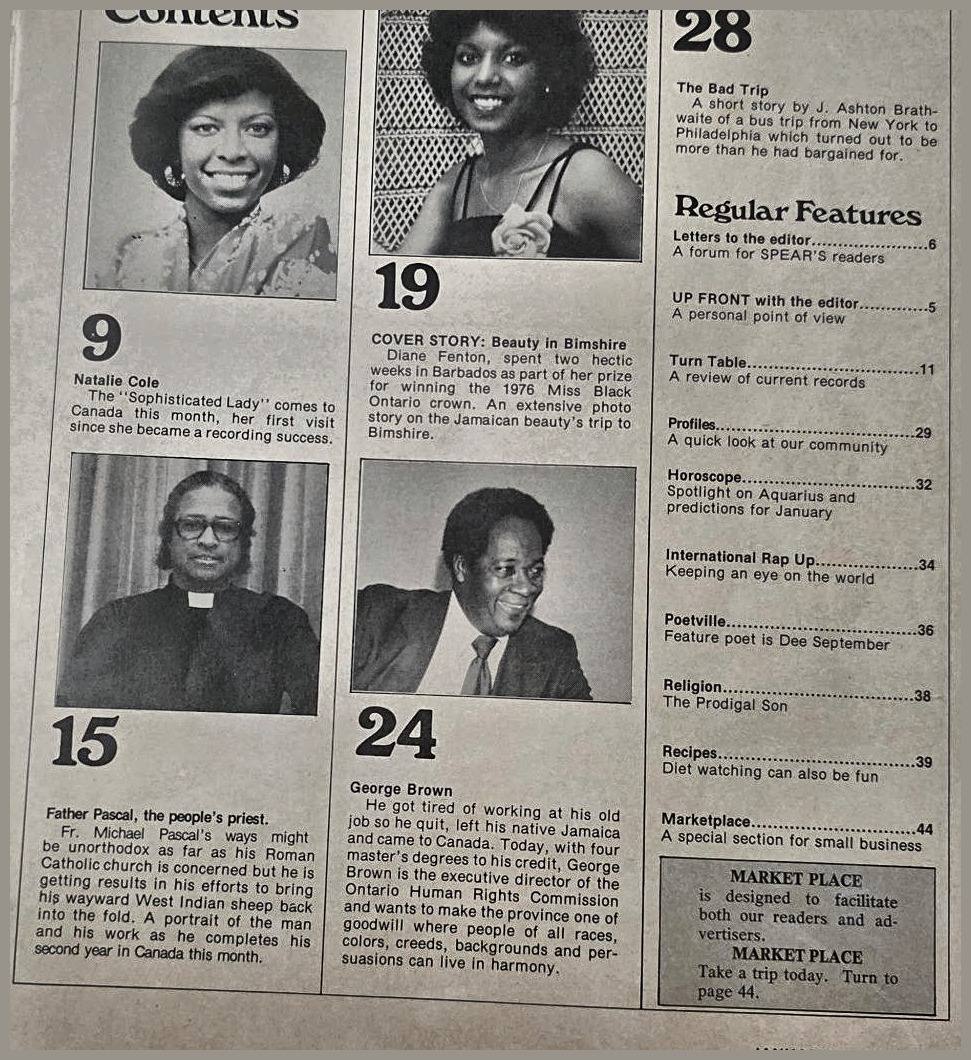
[The contents page lists four featured items with photographs, plus the regular features. The item for this article, no. 15, is transcribed in full; the rest is noted briefly below.]
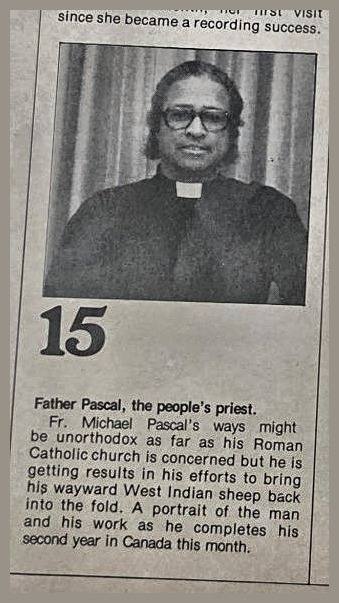
15
Father Pascal, the people's priest.
Fr. Michael Pascal's ways might be unorthodox as far as his Roman Catholic church is concerned but he is getting results in his efforts to bring his wayward West Indian sheep back into the fold. A portrait of the man and his work as he completes his second year in Canada this month.
[The contents page's other featured items: 9 — Natalie Cole, "The 'Sophisticated Lady' comes to Canada this month"; 19 — COVER STORY: Beauty in Bimshire (Diane Fenton, winner of the 1976 Miss Black Ontario crown, in Barbados); 24 — George Brown, executive director of the Ontario Human Rights Commission; 28 — The Bad Trip, a short story by J. Ashton Brathwaite. Regular Features: Letters to the editor (p.6); UP FRONT with the editor (p.5); Turn Table (p.11); Profiles (p.29); Horoscope (p.32); International Rap Up (p.34); Poetville (p.36); Religion — The Prodigal Son (p.38); Recipes (p.39); Marketplace (p.44).]
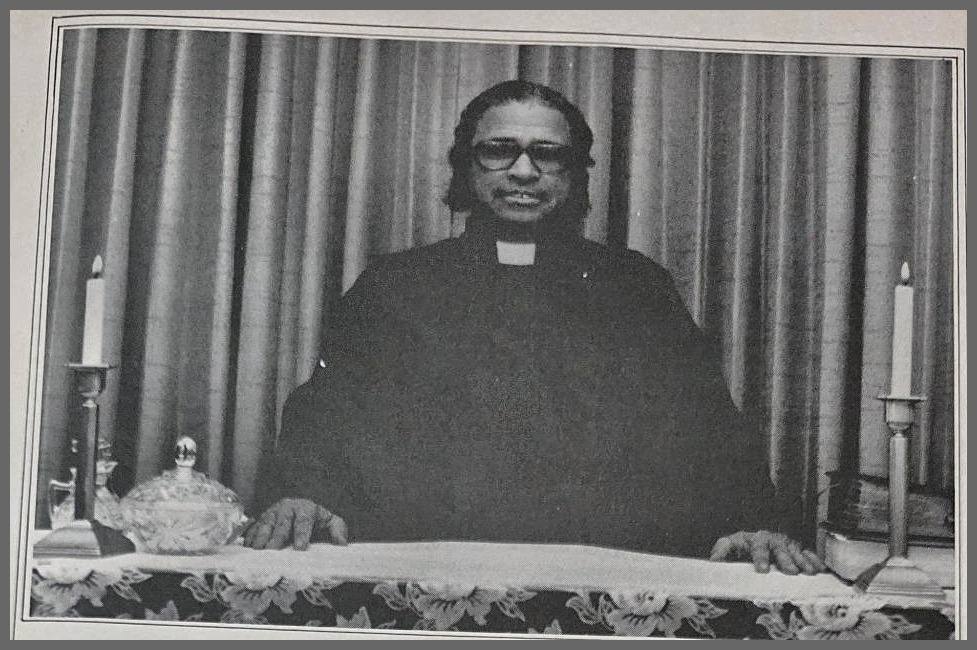
[Photo: Fr. Pascal seated at an altar between two lit candles — full-page portrait.]
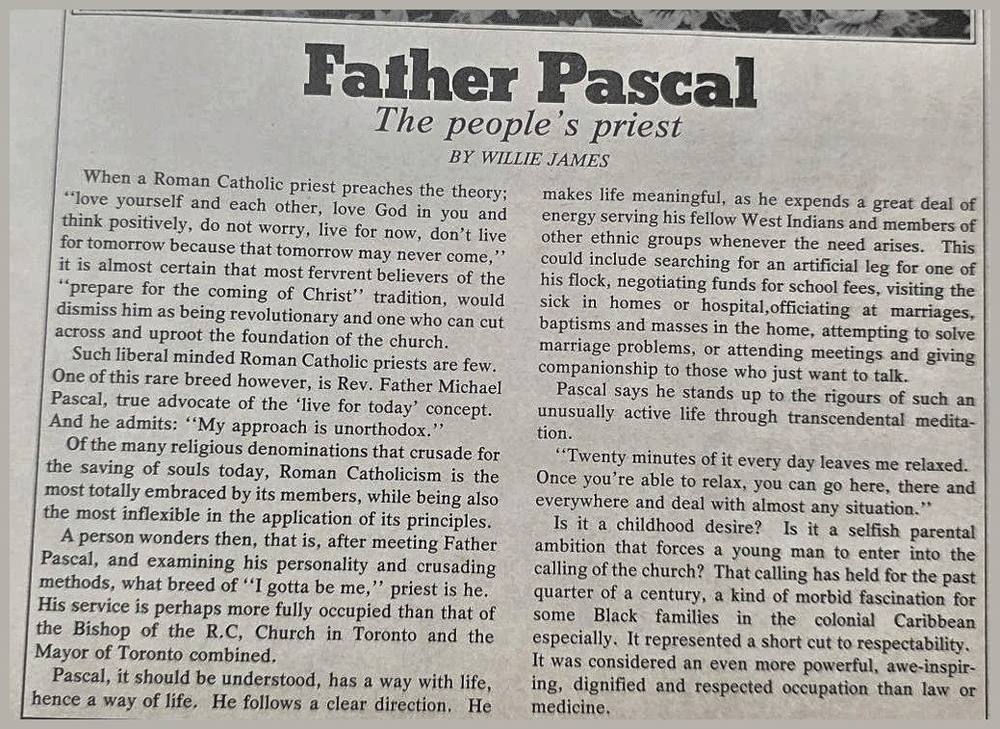
The people's priest
BY WILLIE JAMES
When a Roman Catholic priest preaches the theory; "love yourself and each other, love God in you and think positively, do not worry, live for now, don't live for tomorrow because that tomorrow may never come," it is almost certain that most fervrent [as printed, for "fervent"] believers of the "prepare for the coming of Christ" tradition, would dismiss him as being revolutionary and one who can cut across and uproot the foundation of the church.
Such liberal minded Roman Catholic priests are few. One of this rare breed however, is Rev. Father Michael Pascal, true advocate of the 'live for today' concept. And he admits: "My approach is unorthodox."
Of the many religious denominations that crusade for the saving of souls today, Roman Catholicism is the most totally embraced by its members, while being also the most inflexible in the application of its principles.
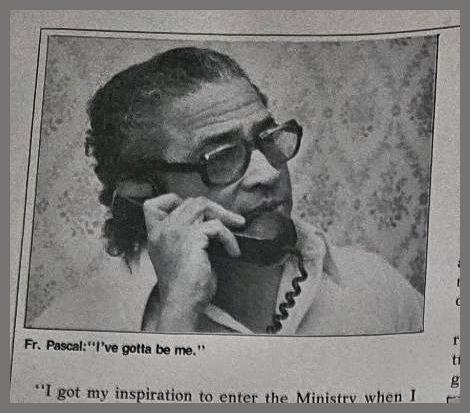
A person wonders then, that is, after meeting Father Pascal, and examining his personality and crusading methods, what breed of "I gotta be me," priest is he. His service is perhaps more fully occupied than that of the Bishop of the R.C. Church in Toronto and the Mayor of Toronto combined.
Pascal, it should be understood, has a way with life, hence a way of life. He follows a clear direction. He makes life meaningful, as he expends a great deal of energy serving his fellow West Indians and members of other ethnic groups whenever the need arises. This could include searching for an artificial leg for one of his flock, negotiating funds for school fees, visiting the sick in homes or hospital, officiating at marriages, baptisms and masses in the home, attempting to solve marriage problems, or attending meetings and giving companionship to those who just want to talk.
Pascal says he stands up to the rigours of such an unusually active life through transcendental meditation.
"Twenty minutes of it every day leaves me relaxed. Once you're able to relax, you can go here, there and everywhere and deal with almost any situation."
Is it a childhood desire? Is it a selfish parental ambition that forces a young man to enter into the calling of the church? That calling has held for the past quarter of a century, a kind of morbid fascination for some Black families in the colonial Caribbean especially. It represented a short cut to respectability. It was considered an even more powerful, awe-inspiring, dignified and respected occupation than law or medicine.
[Footer: JANUARY 1977 SPEAR 15]
[Photo: Fr. Pascal on the telephone — "Fr. Pascal: 'I've gotta be me.'"]
"I got my inspiration to enter the Ministry when I was 16 years old at St. Mary's College, in Trinidad. I was inspired by Father Toba Valdez. He was my hero. I idolized him as he was exceedingly versatile. He taught classes and coached in soccer and boxing," says Pascal, with a youthful grin. He is seated behind his desk in his office on 862 College St., Toronto. He is a la mode with long, wavy brown hair. He is free of the collar worn by priests, but wears a stylish pinkish shirt-jac over light-colored slacks and brown boots. He is browned-skinned, some 5 ft. 6 ins. with the physique of a middle weight boxer.
And his face is pleasant. It reminds the onlooker of a person of South American extract. It could be Carib.
Pascal was born in Belmont, Trinidad, West Indies, in 1930. And, with two other brothers and two sisters, he was given a strict religious upbringing.
Attending mass every Sunday was something of an event of spiritual fulfilment. And that was compulsory. Says Pascal: "In some respects, my upbringing tended to make me, particularly, shy and negative. In those days too, you weren't allowed to think for yourself."
His parents, in his opinion, were very sweet human beings. He says his father, a government quarry manager, was a beautiful, perfect gentleman and his housewife mother was divine and adorable. "The impression my father left on me is indelible," declares Pascal.
School days were tolerable. He was a better than average student. He attended Belmont Intermediate and then went on to St. Mary's College, a Roman Catholic institution.
"When I told my parents I wanted to enter the Ministry they were absolutely delighted. My grandfather demonstrated his pleasure by presenting me with two hundred dollars as a gift."
Pascal arrived in Canada in 1946 and began his training for the priesthood at the Novitiote [as printed, for "Novitiate"], Quebec. After one year of study, he left for Kimmage, Dublin, Ireland, where he was engaged, for two years, in the study of philosophy.
[Right column, above the photograph:]
He returned to Trinidad and assumed a post, teaching at his Alma Mater, St. Mary's College. Pascal taught Biology, French, English and Maths at the college for three years before he gave up the post and went back to Ireland where he studied theology for four years. He was ordained in 1956.
After his ordination, he accepted a posting in Biafra, Nigeria, Africa, where he served for 10 years. As he puts it: "Biafra was the most fulfilling period of my life, and any approach to life as I see it now, was developed in Africa.
"Combine the cultural, spiritual, social backgrounds and attitudes of the African people as against the negative teaching earlier in my life in Trinidad. They differ so sharply, its lamentable."
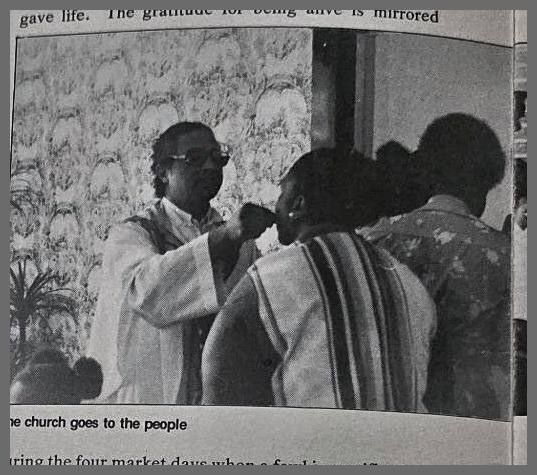
As a priest, Pascal grew to appreciate the African religious philosophy of 'give and take'. The ancient tradition paid homage, respect and love to God who gave life. The gratitude for being alive is mirrored
[Photo: Fr. Pascal giving communion outdoors — "The church goes to the people". The sentence continues below the photograph:]
during the four market days when a fowl is sacrificed on each day.
Pascal observes: "The Christian religion embraces this 'sacrifice concept', but in a different way. We use bread with wine which is symbolic of the body and blood of Christ. There is a constant reacting of the death and resurrection of Christ."
For the 10 years Pascal spent in Biafra, he was attached to the Akpu Parish Catholic Mission.
His work was later hailed as having been invaluable to the community.
He introduced the first agricultural project in the name of the Akpu Young Farmers Club. The vision then was to witness the birth of an idea that would develop into an agricultural college.
The Nigerian war was declared in 1967 and shattered this vision. Shortly after, Pascal who had contracted a rare African ailment was forced to leave Nigeria for medical treatment in Ireland. He was put on the critical list but miraculously recovered some months after.
[Footer: 16 SPEAR JANUARY 1977]
He returned to his native Trinidad, and, says he: "It was a rather difficult period of my life in which I struggled desperately to readjust. I couldn't understand the Trinidad attitude."
Pascal was based in the district of Cedros. He saw the plight of the people and pledged to continue in Cedros, the work which he considered unfinished in Akpu, Biafra. He began the movement towards a fishing cooperative for the people of Cedros.
Carnival came and Pascal exploited it to the fullest for the benefit of Cedros. He led a demonstration band and dramatically put across the plight of Cedros to thousands of people, creating a sensation in the process. He was the first priest ever to lead a carnival band in Trinidad.
"Government," he says, "was shamelessly negligent. It was my view that if Cedros was part of Trinidad, government needed to be realistic."
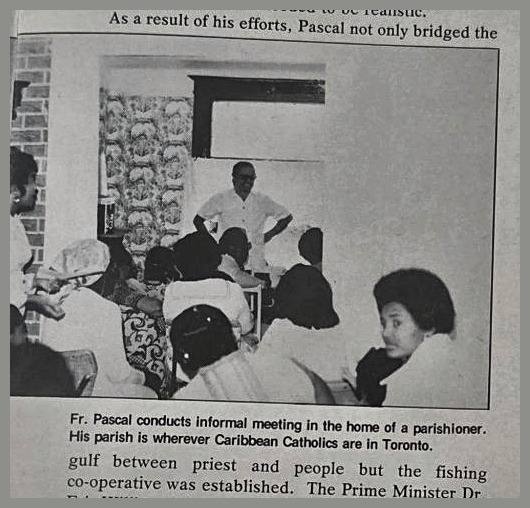
As a result of his efforts, Pascal not only bridged the
[Photo: Fr. Pascal standing before a seated group in a parishioner's home — "Fr. Pascal conducts informal meeting in the home of a parishioner. His parish is wherever Caribbean Catholics are in Toronto." The sentence continues below the photograph:]
gulf between priest and people but the fishing co-operative was established. The Prime Minister Dr. Eric Williams himself, travelled to Cedros and declared it open.
Pascal's efforts were both recognised and applauded. Government bestowed upon him the 'Humming Bird' medal for service to the community.
He also received the gift of a van on behalf of the people of Cedros with the compliments of the government of Venezuela. The gift was presented by Senora Irrazabal [as printed], wife of the Venezuelan Ambassador to Trinidad.
The fight and struggle for the spiritual, social and economic development of Cedros waged on for six years, but so little, comparatively, was accomplished.
It occured [as printed] to him then that the spiritual aspect of the lives of the people of Cedros was non existent, that they simply weren't interested in religion.
By that time, Pascal had revisited Canada on holiday. He lunched with The Holy Ghost Fathers of the Neil
[Right column — the sentence continues from the foot of the left column:]
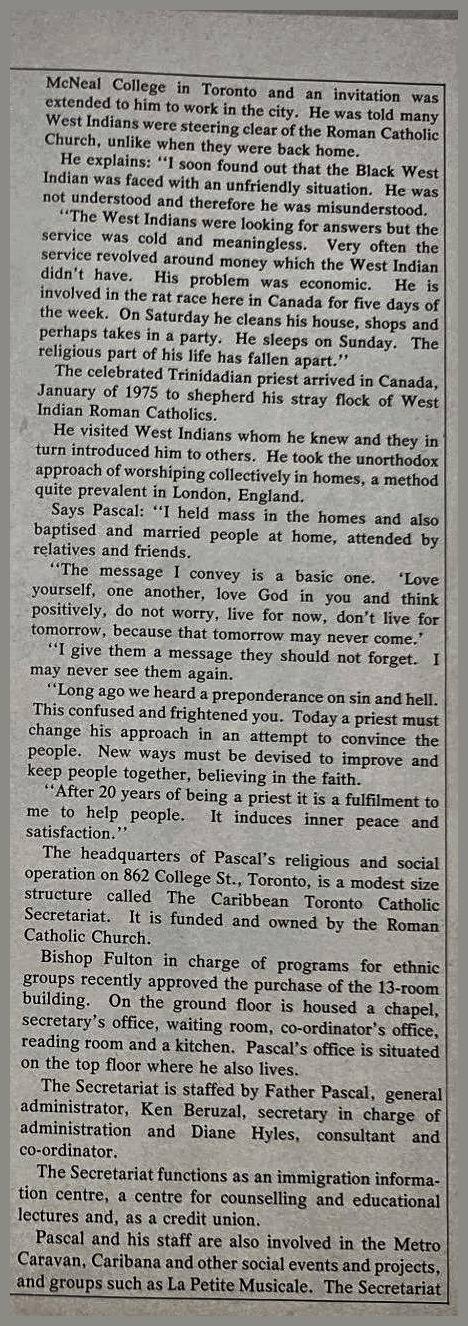
McNeal College in Toronto and an invitation was extended to him to work in the city. He was told many West Indians were steering clear of the Roman Catholic Church, unlike when they were back home.
He explains: "I soon found out that the Black West Indian was faced with an unfriendly situation. He was not understood and therefore he was misunderstood.
"The West Indians were looking for answers but the service was cold and meaningless. Very often the service revolved around money which the West Indian didn't have. His problem was economic. He is involved in the rat race here in Canada for five days of the week. On Saturday he cleans his house, shops and perhaps takes in a party. He sleeps on Sunday. The religious part of his life has fallen apart."
The celebrated Trinidadian priest arrived in Canada, January of 1975 to shepherd his stray flock of West Indian Roman Catholics.
He visited West Indians whom he knew and they in turn introduced him to others. He took the unorthodox approach of worshiping collectively in homes, a method quite prevalent in London, England.
Says Pascal: "I held mass in the homes and also baptised and married people at home, attended by relatives and friends.
"The message I convey is a basic one. 'Love yourself, one another, love God in you and think positively, do not worry, live for now, don't live for tomorrow, because that tomorrow may never come.'
"I give them a message they should not forget. I may never see them again.
"Long ago we heard a preponderance on sin and hell. This confused and frightened you. Today a priest must change his approach in an attempt to convince the people. New ways must be devised to improve and keep people together, believing in the faith.
"After 20 years of being a priest it is a fulfilment to me to help people. It induces inner peace and satisfaction."
The headquarters of Pascal's religious and social operation on 862 College St., Toronto, is a modest size structure called The Caribbean Toronto Catholic Secretariat. It is funded and owned by the Roman Catholic Church.
Bishop Fulton in charge of programs for ethnic groups recently approved the purchase of the 13-room building. On the ground floor is housed a chapel, secretary's office, waiting room, co-ordinator's office, reading room and a kitchen. Pascal's office is situated on the top floor where he also lives.
The Secretariat is staffed by Father Pascal, general administrator, Ken Beruzal, secretary in charge of administration and Diane Hyles, consultant and co-ordinator.
The Secretariat functions as an immigration information centre, a centre for counselling and educational lectures and, as a credit union.
Pascal and his staff are also involved in the Metro Caravan, Caribana and other social events and projects, and groups such as La Petite Musicale. The Secretariat
[Footer: JANUARY 1977 SPEAR 17]
[The article concludes in a two-column block at the top of the page; the sentence continues from the foot of Spear p.17:]
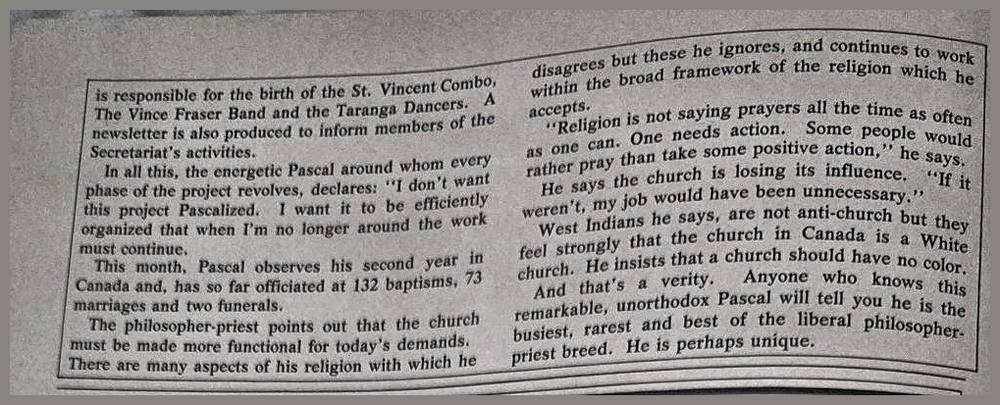
is responsible for the birth of the St. Vincent Combo, The Vince Fraser Band and the Taranga Dancers. A newsletter is also produced to inform members of the Secretariat's activities.
In all this, the energetic Pascal around whom every phase of the project revolves, declares: "I don't want this project Pascalized. I want it to be efficiently organized that when I'm no longer around the work must continue."
This month, Pascal observes his second year in Canada and, has so far officiated at 132 baptisms, 73 marriages and two funerals.
The philosopher-priest points out that the church must be made more functional for today's demands. There are many aspects of his religion with which he disagrees but these he ignores, and continues to work within the broad framework of the religion which he accepts.
"Religion is not saying prayers all the time as often as one can. One needs action. Some people would rather pray than take some positive action," he says.
He says the church is losing its influence. "If it weren't, my job would have been unnecessary."
West Indians he says, are not anti-church but they feel strongly that the church in Canada is a White church. He insists that a church should have no color.
And that's a verity. Anyone who knows this remarkable, unorthodox Pascal will tell you he is the busiest, rarest and best of the liberal philosopher-priest breed. He is perhaps unique.
[Footer: 18 SPEAR JANUARY 1977]
[Page furniture, Spear p.18: the rest of the page is a full-page Province of Ontario advertisement, "Apprenticeship training prepares people to enter skilled trades and earn a better living" (Ministry of Colleges and Universities; Harry C. Parrott, DDS, Minister; William G. Davis, Premier). It is not part of the article and is not transcribed.]