Article A31 · Book 1 · Scrapbook page p.28
Giving up the Church's treasures
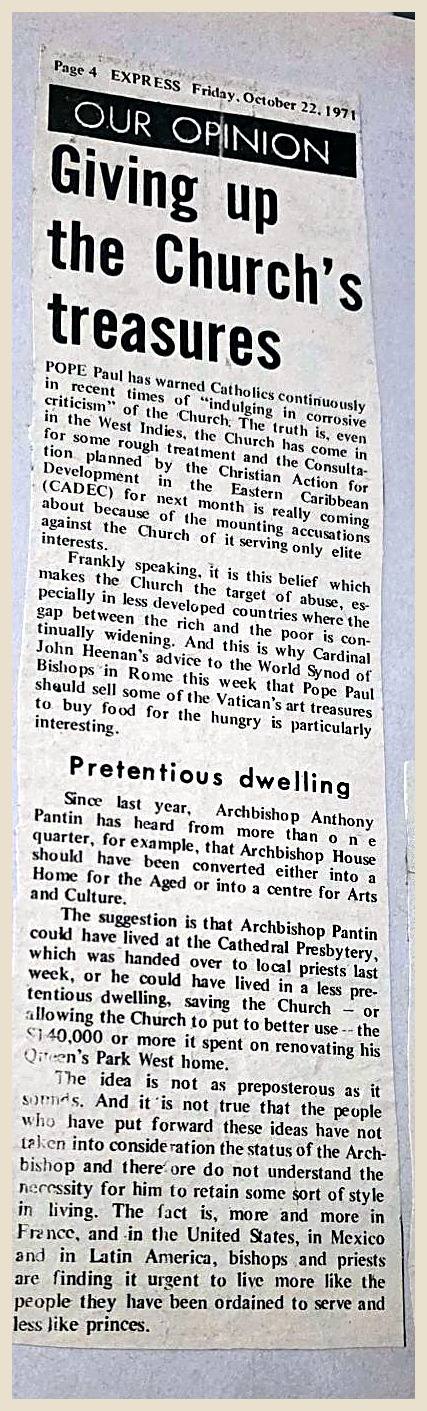
POPE Paul has warned Catholics continuously in recent times of "indulging in corrosive criticism" of the Church. The truth is, even in the West Indies, the Church has come in for some rough treatment and the Consultation planned by the Christian Action for Development in the Eastern Caribbean (CADEC) for next month is really coming about because of the mounting accusations against the Church of it serving only elite interests.
Frankly speaking, it is this belief which makes the Church the target of abuse, especially in less developed countries where the gap between the rich and the poor is continually widening. And this is why Cardinal John Heenan's advice to the World Synod of Bishops in Rome this week that Pope Paul should sell some of the Vatican's art treasures to buy food for the hungry is particularly interesting.
Pretentious dwelling
Since last year, Archbishop Anthony Pantin has heard from more than one quarter, for example, that Archbishop House should have been converted either into a Home for the Aged or into a centre for Arts and Culture.
The suggestion is that Archbishop Pantin could have lived at the Cathedral Presbytery, which was handed over to local priests last week, or he could have lived in a less pretentious dwelling, saving the Church — or allowing the Church to put to better use — the $140,000 or more it spent on renovating his Queen's Park West home.
The idea is not as preposterous as it sounds. And it is not true that the people who have put forward these ideas have not taken into consideration the status of the Archbishop and therefore do not understand the necessity for him to retain some sort of style in living. The fact is, more and more in France, and in the United States, in Mexico and in Latin America, bishops and priests are finding it urgent to live more like the people they have been ordained to serve and less like princes.
[Continuation piece]
Drastic changes
It is wrong, of course, to suggest by repeating this criticism that the Archbishop, by remaining in Queen's Park West, is unaware of the conscientizacion which is bringing about drastic changes in the Church in other parts of the world. It is an understanding of this spirit, indeed, and an understanding of the need for the Church to mean more to the people of grassroot origins which prompted his approval of the work which Brother Gerard is doing in Laventille and the involvement of Father Pascall in the life of Cedros.
But these are slight commitments, tiny grains of sand on the shores of the Church's historic indifference to the needs of the population. Fr. Ross's decision recently, as another example, to give up the presbytery at Tunapuna for the use as a school and to find a "smaller house" somewhere in his parish does not convert disbelievers in other districts who still regard their priests as a privileged class.
We have dealt with only the Roman Catholic Church where we can find ready examples of an attempt to effect changes in old attitudes — but this hostility is directed at all the churches in the islands.