Article A27 · Book 1 · Scrapbook page pp.23–24
An investigation by Kit Roxburgh (the Cedros Fishermen's Co-operative)
[Scrapbook page 23, piece 1 — first column]
TAKE a people who have been suffering for centuries, doing the same things to survive in the same way.
Talk to them, explain to them logically that it would not be too difficult for them to raise their standard of living, try to get them work together and trust each other, to put aside, even temporarily, petty prejudices. Ask some experts to lend a hand.
And what happens?
What is taking place in the beautiful, long stretch of unpredictable sea and rolling hills that is called Cedros, on the south-western tip of Trinidad, provides the all-too-common answer.
The good road stops at Point Fortin. But progress, for Cedros, seems to have come to a halt 30 years ago. The three villages along the peninsular, Granville, Fullerton and Bonasse, appear to have changed very little or not at all since the days of Massa.
[Piece 2 — continuation of the same column, scrapbook page 23]
HAZARDOUS
"It's so dead up here" a woman who works in a club told me "that whenever a man wants to dodge a warrant he still heads for Cedros. I know a man who has been hiding up here from the law for over 18 years."
The ten thousand or so residents have choice — the same choice their fathers and forefathers were faced with: work on an estate or in a fishing boat.
Turning to the seas is hazardous enough; there are always Venezuelan jails treacherous currents and temperamental old engines that have to be accepted as a way of life.
Most crushing of all, though are the prices they get for their catches — about half the retail price.
As for the land, this is what a recently circulated Black Power Pamphlet had to say:
"We have slavery on the plantations of Cedros. Black brothers and sisters have to produce 135 bags of copra for $3 and $4 a day.
"There is no hospital. There is no local control of resources."
[Piece 1 — second column, scrapbook page 23]
"We must organise in the homes and the clubs, because we must realise that the strength of the community lies in the organisation of the people."
Unquestionably, there is need for the people of Cedros to change their pattern of life.
Tragically the solution that appears to be most obvious does not seem workable in the community.
Because of the lack of capital but the abundance of skills in fishing and agriculture it seems clear that there must be a pooling of resources in one or both these fields.
For the present, agriculture (and coconuts are the main products) seems to be less feasible, since it cannot provide the immediate support of say, one-tenth of the population.
Nor can it be assumed that the acquisition of any of the large estates would be easy.
Which leaves the sea and brings us to the formation of the Cedros Co-operative Fishing Society.
Suspicion hangs heavy here. It emanates
[Piece 3 — scrapbook page 23, the column under the byline headline]
both from the ingrained distrust that is felt by a people who have known only one way to exist and are wary of newness and from the actual financial position of the co-op.
It began with a loan from a bank of $18,000. That was early this year. By the end of May, according to government auditors, the co-op had bought $113,000 in fish and shrimp, sold this for $126,000.
Which would have meant a profit of $13,000 — except that $11,000 went in wages and commissions, $10,000 went in a building and $1,000 for rental of a truck.
All in all the liability amounted to about $30,000.
Just after this was announced, a Port-
[Piece 4 — photograph, scrapbook page 23: a pile of fish. No caption on the preserved clipping.]
[Scrapbook page 24, piece 1 — two columns]
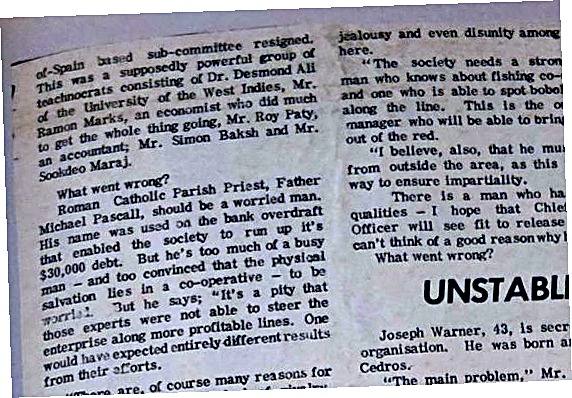
of-Spain based sub-committee resigned. This was a supposedly powerful group of technocrats consisting of Dr. Desmond Ali of the University of the West Indies, Mr. Ramon Marks, an economist who did much to get the whole thing going, Mr. Roy Faty, an accountant; Mr. Simon Baksh and Mr. Sookdeo Maraj.
What went wrong?
Roman Catholic Parish Priest, Father Michael Pascall, should be a worried man. His name was used on the bank overdraft that enabled the society to run up it's $30,000 debt. But he's too much of a busy man — and too convinced that the physical salvation lies in a co-operative — to be worried. But he says; "It's a pity that those experts were not able to steer the enterprise along more profitable lines. One would have expected entirely different results from their efforts."
"There are, of course many reasons for this, you'll find a great deal of rivalry,
[second column]
jealousy and even disunity among the races here.
"The society needs a strong man, a man who knows about fishing co-operatives and one who is able to spot bobol anywhere along the line. This is the only kind of manager who will be able to bring the co-op out of the red.
"I believe, also, that he must be a man from outside the area, as this is the only way to ensure impartiality.
There is a man who has all these qualities — I hope that Chief Fisheries Officer will see fit to release him, and I can't think of a good reason why he shouldn't.
What went wrong?
[Piece 2 — photograph, scrapbook page 24, with caption beside it]
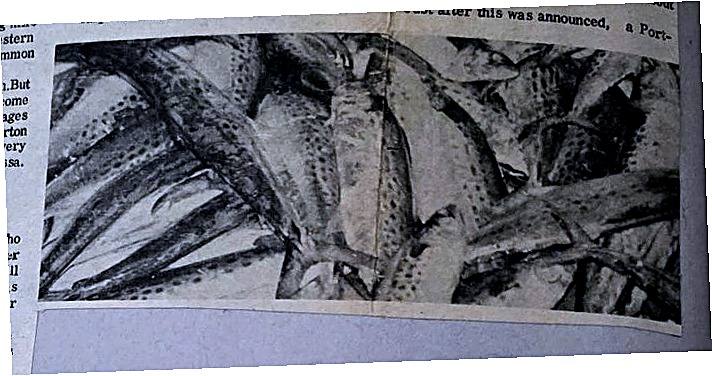
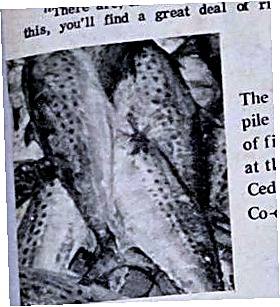
The pile up of fish at the Cedros Co-op.
[Piece 4 — masthead strip glued on scrapbook page 24]
[EXPRE]SS Tuesday, August 17, 1971 Page 11
[Piece 3 — scrapbook page 24]
UNSTABLE
Joseph Warner, 43, is secretary of the organisation. He was born and raised in Cedros.
"The main problem," Mr. Warner told me at the co-op's office on the beach last Saturday, "is markets. Prices are very unstable and the retailers because they have nothing to lose and are not concerned about what happens to the Cedros fishermen are able to drive a hard bargain.
"Sometimes we sell fish at 25 cents a pound when we paid 30 cents for it.
This is what happens at the Port-of-Spain and San Fernando markets.
I asked him why hadn't the group, after eight months operation, set up a retailing system of their own to counteract the cut-throat practices existing in the main markets.
"We are thinking of getting at least two stalls in town and San Fernando," he said.
What about cold storage? Couldn't they
[Piece 5 — first column, scrapbook page 24; the tall right-hand piece]
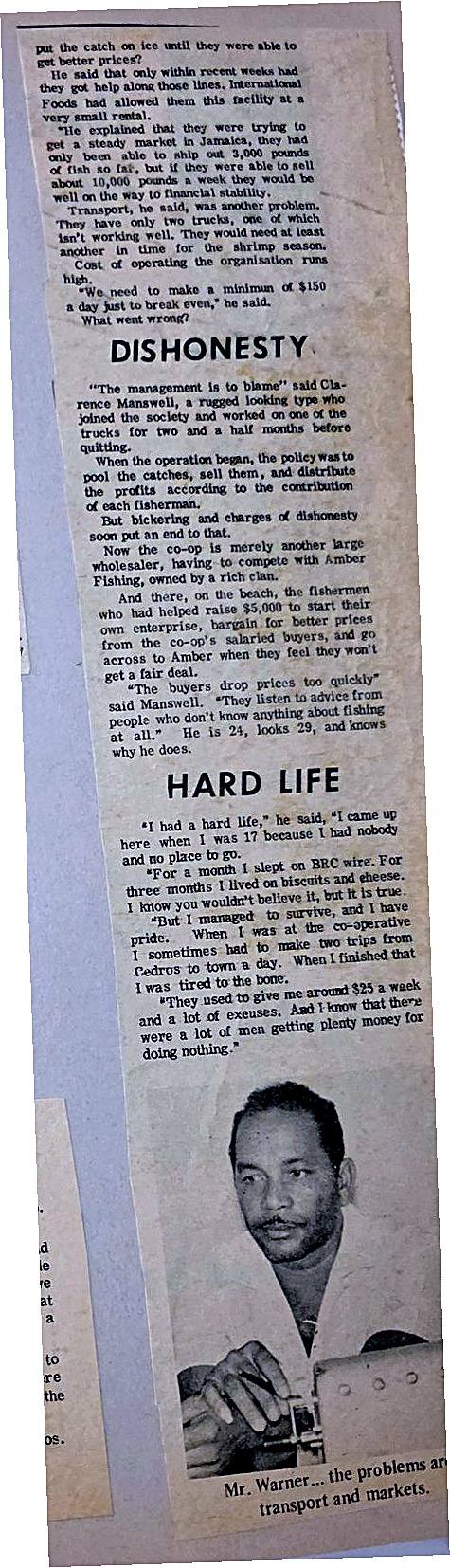
put the catch on ice until they were able to get better prices?
He said that only within recent weeks had they got help along those lines. International Foods had allowed them this facility at a very small rental.
"He explained that they were trying to get a steady market in Jamaica, they had only been able to ship out 3,000 pounds of fish so far, but if they were able to sell about 10,000 pounds a week they would be well on the way to financial stability.
Transport, he said, was another problem. They have only two trucks, one of which isn't working well. They would need at least another in time for the shrimp season.
Cost of operating the organisation runs high.
"We need to make a minimum of $150 a day just to break even," he said.
What went wrong?
DISHONESTY
"The management is to blame" said Clarence Manswell, a rugged looking type who joined the society and worked on one of the trucks for two and a half months before quitting.
When the operation began, the policy was to pool the catches, sell them, and distribute the profits according to the contribution of each fisherman.
But bickering and charges of dishonesty soon put an end to that.
Now the co-op is merely another large wholesaler, having to compete with Amber Fishing, owned by a rich clan.
And there, on the beach, the fishermen who had helped raise $5,000 to start their own enterprise, bargain for better prices from the co-op's salaried buyers, and go across to Amber when they feel they won't get a fair deal.
"The buyers drop prices too quickly" said Manswell. "They listen to advice from people who don't know anything about fishing at all." He is 24, looks 29, and knows why he does.
HARD LIFE
"I had a hard life," he said, "I came up here when I was 17 because I had nobody and no place to go.
"For a month I slept on BRC wire. For three months I lived on biscuits and cheese. I know you wouldn't believe it, but it is true.
"But I managed to survive, and I have pride. When I was at the co-operative I sometimes had to make two trips from Cedros to town a day. When I finished that I was tired to the bone.
"They used to give me around $25 a week and a lot of excuses. And I know that there were a lot of men getting plenty money for doing nothing."
[Photograph, scrapbook page 24, bottom of piece 5: portrait of Joseph Warner at a typewriter. Caption:]
Mr. Warner... the problems ar[cut off in photo] transport and markets.
[Piece 5, scrapbook page 23 — the banner piece. Headline completes on scrapbook page 24: "solve the problem"]
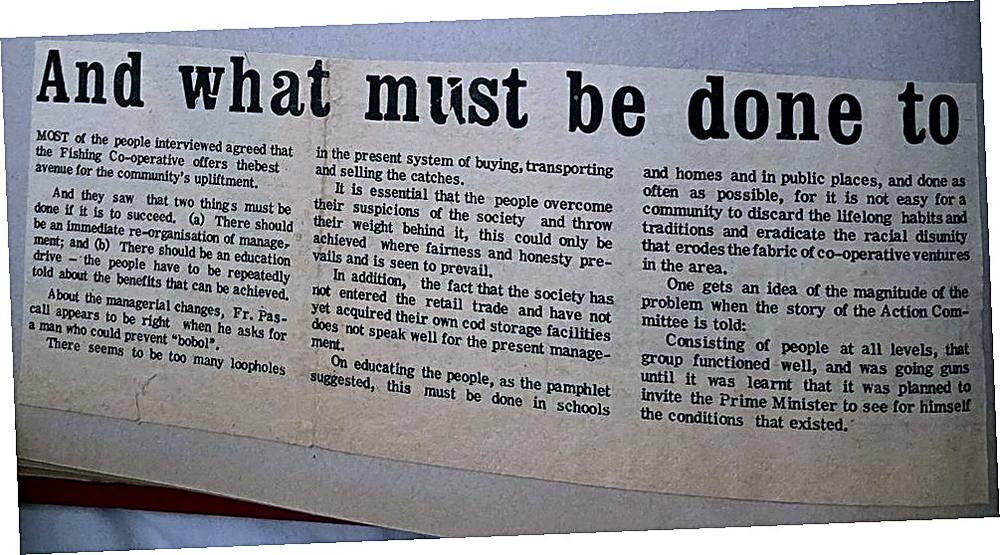
MOST of the people interviewed agreed that the Fishing Co-operative offers the best avenue for the community's upliftment.
And they saw that two things must be done if it is to succeed. (a) There should be an immediate re-organisation of management; and (b) There should be an education drive — the people have to be repeatedly told about the benefits that can be achieved.
About the managerial changes, Fr. Pascall appears to be right when he asks for a man who could prevent "bobol".
There seems to be too many loopholes in the present system of buying, transporting and selling the catches.
It is essential that the people overcome their suspicions of the society and throw their weight behind it, this could only be achieved where fairness and honesty prevails and is seen to prevail.
In addition, the fact that the society has not entered the retail trade and have not yet acquired their own cod storage facilities does not speak well for the present management. (“cod storage” as printed; evidently “cold storage”.)
On educating the people, as the pamphlet suggested, this must be done in schools and homes and in public places, and done as often as possible, for it is not easy for a community to discard the lifelong habits and traditions and eradicate the racial disunity that erodes the fabric of co-operative ventures in the area.
One gets an idea of the magnitude of the problem when the story of the Action Committee is told:
Consisting of people at all levels, that group functioned well, and was going guns until it was learnt that it was planned to invite the Prime Minister to see for himself the conditions that existed.
[Piece 6 — scrapbook page 24; completes the banner headline]
That, stupidly enough, caused the big rift. Forgotten was the fact that Dr. Williams was the man who could help most effectively.
Forgotten was the fact that the Member of Parliament for that constituency Mr. Roy Richardson had so often been referred to as "half dead."
As far as one large segment of the group was concerned, Dr. Williams was being asked to come and do some electioneering which would benefit only one race.
Another point: Cedros hit the headlines when the people marched through the streets of Port of Spain at Carnival, the first real protest band from a country area to do so.
They were demanding a hospital.
The fact, is, Cedros had a hospital, and it was closed down because of the attitude of the people themselves who apparently have a strange habit of rejecting anything that is meant primarily for their benefit as a whole.
They continuously took their sick to Point Fortin or San Fernando and there were several malicious letters about the medical staff stationed at Cedros.
The letters were posted from Cedros.